

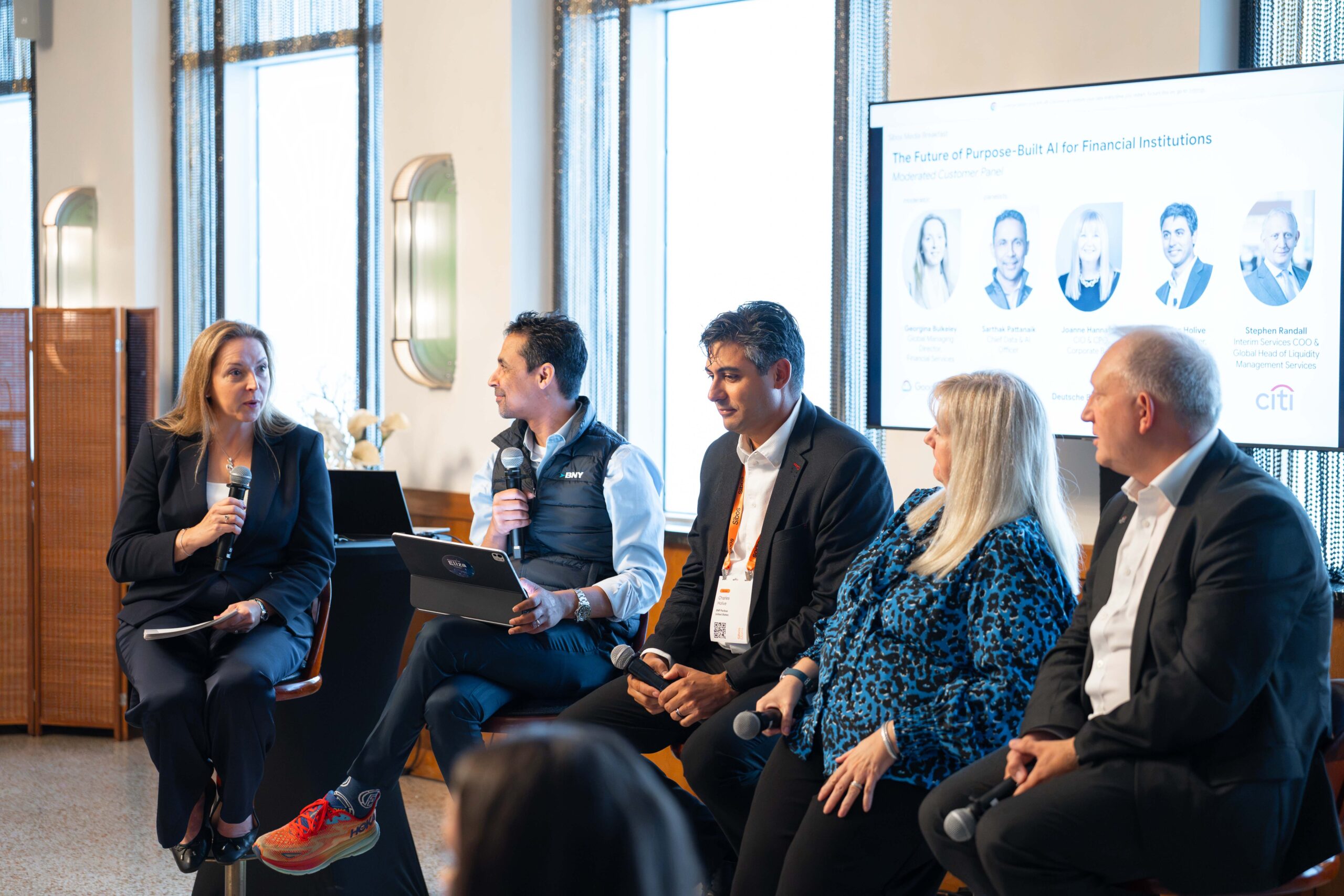
Banks Move AI from Experimentation to Enterprise Scale at SIBOS
At SIBOS, senior technology and AI leaders from Deutsche Bank, BNP Paribas, BNY and Citi joined Google Cloud for a media roundtable focused on how financial institutions are moving artificial intelligence from experimentation into enterprise-scale deployment.
A central message from the discussion was clear: financial services is entering an agentic AI era, in which AI systems can reason across complex information, execute multi-step workflows and support employees in making faster, better-informed decisions.
For banks operating in highly regulated environments, however, the conversation is no longer simply about what AI can do. It is increasingly about how it can be deployed safely, at scale and with measurable business value.
From pilots to transformation
Jo Hannaford, CIO and CPO of Deutsche Bank’s Corporate Bank, described the bank’s AI journey as a transition from experimentation to industrial scale. Deutsche Bank has developed an agentic AI framework, known as ADA, designed to allow agents to be reused across different applications.
Hannaford highlighted two broad categories of AI use cases in financial services: process optimisation and financial intelligence. While automation can improve operational efficiency, she argued that the greater opportunity lies in using AI to synthesise financial and market information and generate actionable intelligence for client-facing teams.
At BNP Paribas, the ambition is similarly extending beyond incremental automation. Charles Holive, Chief AI Officer for Corporate and Institutional Banking, said the bank is treating AI as a business driver rather than simply a technology or cost initiative.
Rather than pursuing thousands of individual proofs of concept, BNP Paribas is focusing on a smaller number of major transformations across its business lines, with the goal of re-architecting processes and changing their underlying economics.
Agentic AI enters the workflow
The discussion also offered concrete examples of how banks are applying agentic AI to everyday financial processes.
At BNP Paribas, one use case focuses on securities-services operations, including trade-break processing. The bank redesigned the workflow before introducing an AI agent to manage parts of the process.
According to Holive, the system initially resolved around 95% of incoming triage cases, while the remaining exceptions became opportunities for the agent to learn from human feedback. Within several weeks, the process reached approximately 80–85% automated efficiency.
BNY is applying a similar concept to payments. Sarthak Pattanaik, Chief Data and AI Officer, described an agentic solution designed to address the small proportion of payment instructions that require manual intervention.
The system combines semantic understanding of payment information—including beneficiaries, currencies, addresses and payment types—with syntactic validation against ISO 20022 standards. It then assesses the broader context of the transaction to determine whether the payment makes sense, while deterministic controls and human intervention remain part of the process.
The distinction is important: rather than replacing existing controls, the AI layer is being used to add reasoning capabilities on top of them.
From efficiency to financial intelligence
For Deutsche Bank, another major opportunity is using AI to improve the quality and speed of financial intelligence.
The bank has co-developed a Financial Insights capability with Google Cloud that brings together financial intelligence, market dynamics and client-specific information. The system can generate recommendations for coverage teams and automate follow-up tasks such as drafting financial memos and credit assessments.
Hannaford said the tool is intended to help relationship teams identify emerging issues before clients themselves have necessarily identified them.
Citi is also exploring agentic AI across areas including liquidity, document processing and wealth management. Stephen Randall, Interim Services COO and Head of Liquidity Management Services, emphasised the importance of combining productivity gains with clear enterprise boundaries.
Governance becomes part of the architecture
If there was one theme connecting the different examples, it was that trust and governance cannot be added after deployment.
Panelists repeatedly highlighted the importance of data governance, observability, regulatory controls and human oversight.
At BNP Paribas, governance involving compliance, legal, cybersecurity and HR is incorporated from the beginning of development. The bank can also use internal infrastructure to prototype sensitive applications before moving proven solutions through full enterprise governance.
At Citi, teams use controls governing which internal and external data sources can be accessed by specific workflows, while maintaining defined human-in-the-loop or human-on-the-loop models.
Deutsche Bank is exploring knowledge-graph approaches to connect semantic information across traditional data structures. According to Hannaford, this has helped accelerate processes such as onboarding and lending in specific parts of the bank.
For BNY, governance is similarly embedded into the data and AI platform itself, with metadata and semantics helping determine whether information can legitimately be used for a particular purpose.
Google puts its own finance operations to the test
Google also presented its own finance organisation as a real-world testing ground for enterprise AI.
Kristin Reinke, VP of Finance at Google, described the company as a “Customer Zero” for its AI technologies. Google has deployed AI across its finance organisation, including invoice validation and executive reporting.
Jason Allen, Assistant Treasurer at Google, highlighted an agentic cash-management system developed for Google’s global treasury operations. The solution uses separate forecasting, evaluation and execution agents to identify excess cash, evaluate where it should be invested and stage transactions for execution.
The company said the system has freed up employee time for higher-value activities while also generating additional interest income.
Importantly, Google stressed that the AI does not make the final investment decision. Human cash managers retain responsibility for the decision, with the technology providing recommendations and reducing the manual work required to reach them.
The next phase of banking AI
The discussion at SIBOS suggests that the industry’s AI conversation is evolving. The focus is moving away from isolated productivity tools and toward AI systems embedded directly into critical financial workflows.
The examples shared by Deutsche Bank, BNP Paribas, BNY and Citi point to a common model: AI performs increasingly complex reasoning and execution, while data controls, deterministic verification, governance and human judgement remain essential.
For financial institutions, the competitive question may therefore be less about who can deploy the biggest AI model and more about who can build the infrastructure, data foundations and governance needed to turn AI capabilities into trusted business processes.
As Google Cloud’s panel made clear, the emerging model is not AI replacing financial professionals, but AI removing friction and augmenting the judgement of the people responsible for financial decisions.